Global Collaboration Led by Dr. Fernanda Valdovinos Awarded $1.5M HFSP Grant to Model Climate Impacts on Marine Ecosystems

Updated: May 6
We are thrilled to announce that a pioneering international research team, led by Dr. Fernanda Valdovinos (UC Davis), has been awarded a highly prestigious Research Grant from the Human Frontier Science Program (HFSP).
The project, titled "Across-Scale Ecological and Evolutionary Responses of Major Upwelling Ecosystems to Climate Change", will receive $500,000 annually over three years. The award is a massive achievement, standing out as one of only 28 funded projects selected from an initial pool of 957 letters of intent worldwide.
The Challenge: Predicting the Future of the Ocean's Most Productive Zones
The world’s four major Eastern Boundary Upwelling Systems—California, Humboldt (Chile), Benguela (South Africa), and Canary (Portugal)—cover less than 1% of the ocean’s surface but generate a staggering 25% of global marine productivity. Because these intertidal ecosystems sit at the boundary of marine and terrestrial climates, they are highly sensitive sentinels of climate change.
Historically, predicting how these complex ecosystems will respond to global warming has been hampered by models that rely on vast oversimplifications. Traditional models often miss the critical, ground-level details of how individual organisms actually experience and adapt to thermal stress.
A Cross-Scale, Data-Theory Framework
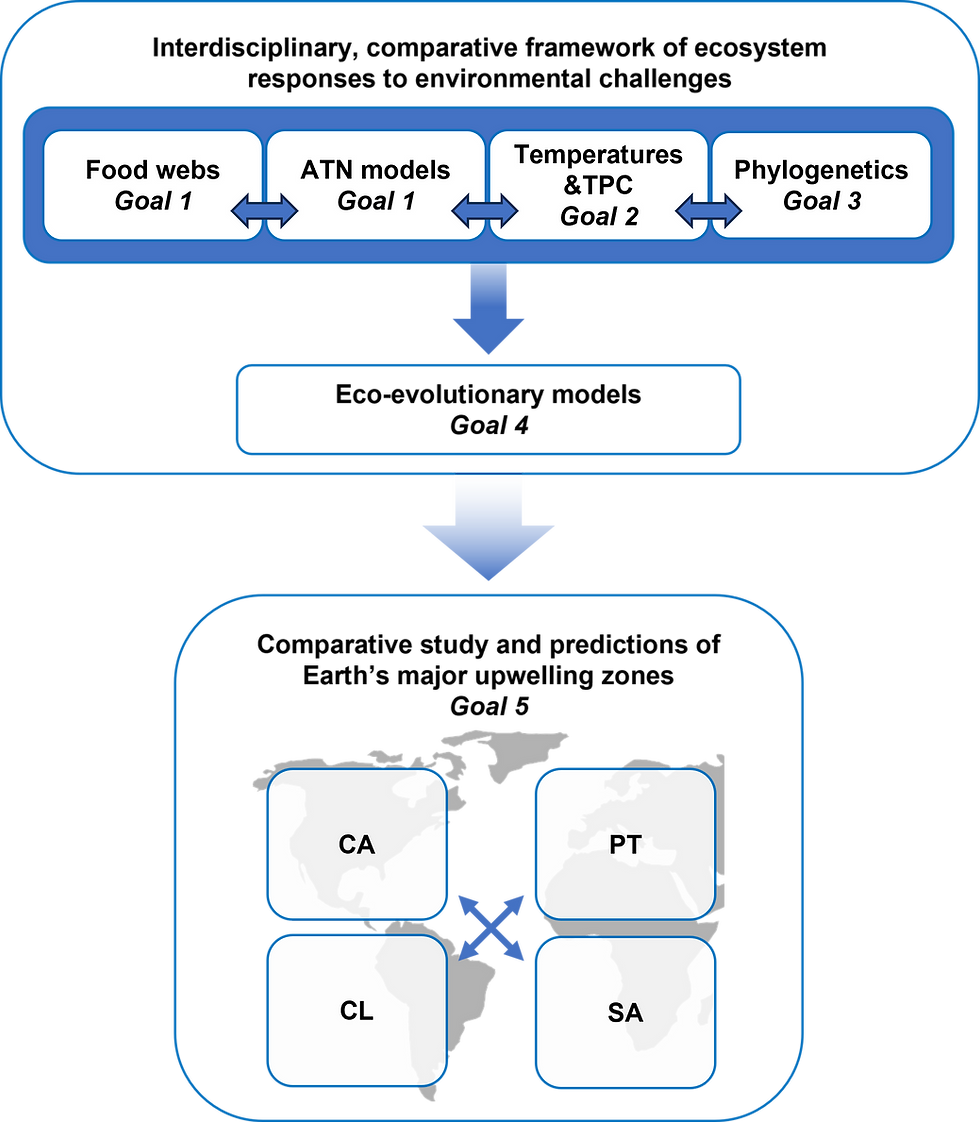
To solve this, the newly funded HFSP project will develop an unprecedented, cross-scale framework that bridges the gap between microscopic organismal physiology and macro-level ecosystem dynamics.
The project will unify four distinct scientific domains:
High-Resolution Environmental Monitoring: Deploying autonomous, biomimetic temperature loggers across the four continents to capture the exact microclimates intertidal organisms experience.
Thermal Physiology: Conducting rigorous laboratory experiments to map the thermal performance and tolerance landscapes of key species in each region.
Network Ecology: Building highly resolved Allometric Trophic Network (ATN) models for all four upwelling regions to simulate how energy flows and how species interactions shift under stress.
Eco-Evolutionary Modeling: Using phylogenetic data and mathematical modeling to understand how species might adapt over time, and how that evolution impacts the stability of the entire food web.
An Intercontinental "Dream Team"
The success of this ambitious project relies on a deeply integrated, interdisciplinary team of co-investigators, each representing one of the four major upwelling regions:

Dr. Fernanda Valdovinos (UC Davis, USA) - Principal Applicant: Leading the network ecology and ATN modeling efforts for the California system and coordinating the global framework.
Dr. Fernando Lima (University of Porto, Portugal): Driving the environmental monitoring and technological innovations, including the deployment of in-situ temperature loggers across the Canary upwelling system and beyond.
Dr. Enrico Rezende (Pontifical Catholic University of Chile): Providing deep expertise in thermal physiology and phylogenetics to predict in-situ thermal mortality in the Humboldt system.
Dr. Cang Hui (Stellenbosch University, South Africa): Specializing in eco-evolutionary theory and the mathematical modeling of adaptive networks within the Benguela system.
By combining empirical measurements with advanced theoretical modeling across four continents, this team is set to usher in a new era of ground-truthed, predictive ecology. Their work will provide vital insights into how our most crucial marine ecosystems will weather the coming decades of climate change.
Congratulations to Dr. Valdovinos, Dr. Lima, Dr. Rezende, and Dr. Hui on this monumental award!


Comments